
Shiekh el Belled, Kom Ombo, Upper Egypt
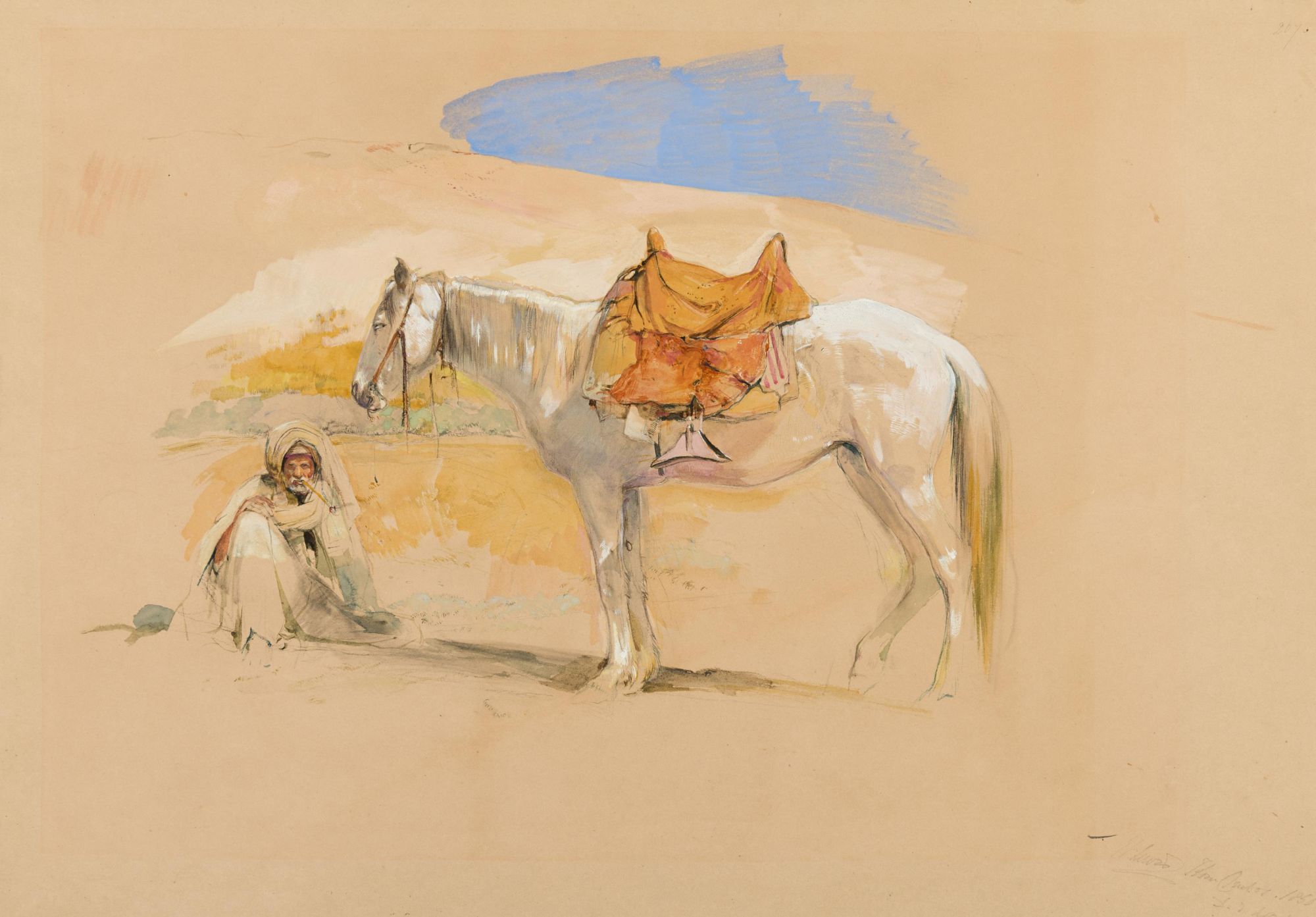
Shiekh el Belled, Kom Ombo, Upper Egypt
Sheikh el Belled, Kom Ombo, Upper EgyptWatercolour and bodycolour, over traces of an under drawing in pencil.Signed, inscribed and dated lower right: J. F. Lewis Kom Ombos. 1850. Watercolour over pencil heightened with bodycolour on buff paper36.7 by 52.6 cm,, 14 ½ by 20 ¾ in.Provenance:Christie's London, The posthumous Lewis studio sale, 4-7 May 1877, lot 132 (unsold);Christie's London, Fifty Remaining Works of that Distinguished Artist, John Frederick Lewis, R.A. (Sold by the Direction of the Widow…), 3 May 1897, lot 39, (bt. W. Rome for £26.5.0);With Thomas Agnew & Sons, Manchester and London;Purchased from them by Arthur Greenlow Lupton, Leeds (1848-1930);Thence by descentLiterature:Emily M. Weeks, Cultures Crossed: John Frederick Lewis and the Art of Orientalism, New Haven and London, 2014, p.182, note 90Exhibited:Probably London, Royal Academy, 1870, no.580 (as A Scheik el Belled, Upper Egypt)During the decade that Lewis spent living in Cairo between 1841 and 1851, he appears to have made only one trip to Upper Egypt, towards the end of this time there, in 1849-1850. He travelled with his wife Marian via Thebes and Edfu, as far south as Philae, where they met Florence Nightingale. She was exploring the region, partly to escape family pressure for her to marry and was apparently taken by the artist's charming manners and local dress.The Lewis's returned to Cairo via Kom Ombo, also known as Kom Umbu or Ombos, which lies about a hundred miles south of Luxor, on the eastern bank of the Nile. It was celebrated for its double temple constructed in the 2nd Century BC, during the Ptolomeic dynasty and dedicated to both the crocodile god Sobek and the falcon god, Horus. During the time that Lewis stayed in the town, he made several drawings of the temple, as well as of the inhabitants of Kom Ombo, including the present sheet. As has been noted of Lewis, 'Time and again, his sketches from his Nile trip reveal that his interest lay in the rural life of Upper Egypt rather than with the ancient monuments that most tourists travelled there to see.' A printed inscription on a former mount, which was probably transcribed from a now-lost label, identifies the subject of this watercolour as the 'Sheikh el Belled' (shaykh al-balad, or the headman of a village). Lewis, at least partially worked on the sheet on the spot, capturing the scene in pencil. However, the areas of paper left unpainted and the rapid effects of the watercolour and bodycolour, add to the overall feeling of spontaneity. The robed figure, wearing a large turban, protecting him from the sun is seated, smoking a pipe, whilst his horse is similarly relaxed, with loosened chin-strap, resting a hind leg and with half-closed eyes. The present large sheet is one of two watercolours with identical titles which were included in the studio sale in May 1877, the year after the Lewis's death. It seems to have been unsold and remained with the artist's widow until May 1897, when it was sold at auction. The present sheet was later acquired from art dealers Agnew's by the Yorkshire councilman, industrialist and university chancellor Arthur Greenlow Lupton (1848-1930). Also drawn at this time was a stylistically comparable watercolour of An Arab with Two Oxen Ploughing at Kom Ombos, which, like the present sheet, was in the 1877 studio sale. Lewis exhibited a watercolour of this title at the Royal Academy exhibition of 1870, indicating the high regard the artist held for the composition. Whether it was the present watercolour, or the other version is uncertain. The other version of this subject was purchased at the posthumous 1877 Lewis studio sale by the London-based framers, gilders and fine art dealers William and John Henry Vokins, who specialized in watercolours.)
John Frederick Lewis R.A. (1805 - 1876)
Sheikh el Belled, Kom Ombo, Upper Egypt
Watercolour and bodycolour, over traces of an under drawing in pencil.
Signed, inscribed and dated lower right: J. F. Lewis Kom Ombos. 1850.
Watercolour over pencil heightened with bodycolour on buff paper
36.7 by 52.6 cm,, 14 ½ by 20 ¾ in.
Provenance:
Christie's London, The posthumous Lewis studio sale, 4-7 May 1877, lot 132 (unsold);
Christie's London, Fifty Remaining Works of that Distinguished Artist, John Frederick Lewis, R.A. (Sold by the Direction of the Widow…), 3 May 1897, lot 39, (bt. W. Rome for £26.5.0);
With Thomas Agnew & Sons, Manchester and London;
Purchased from them by Arthur Greenlow Lupton, Leeds (1848-1930);
Thence by descent
Literature:
Emily M. Weeks, Cultures Crossed: John Frederick Lewis and the Art of Orientalism, New Haven and London, 2014, p.182, note 90
Exhibited:
Probably London, Royal Academy, 1870, no.580 (as A Scheik el Belled, Upper Egypt)
During the decade that Lewis spent living in Cairo between 1841 and 1851, he appears to have made only one trip to Upper Egypt, towards the end of this time there, in 1849-1850. He travelled with his wife Marian via Thebes and Edfu, as far south as Philae, where they met Florence Nightingale. She was exploring the region, partly to escape family pressure for her to marry and was apparently taken by the artist's charming manners and local dress.
The Lewis's returned to Cairo via Kom Ombo, also known as Kom Umbu or Ombos, which lies about a hundred miles south of Luxor, on the eastern bank of the Nile. It was celebrated for its double temple constructed in the 2nd Century BC, during the Ptolomeic dynasty and dedicated to both the crocodile god Sobek and the falcon god, Horus. During the time that Lewis stayed in the town, he made several drawings of the temple, as well as of the inhabitants of Kom Ombo, including the present sheet. As has been noted of Lewis, 'Time and again, his sketches from his Nile trip reveal that his interest lay in the rural life of Upper Egypt rather than with the ancient monuments that most tourists travelled there to see.'
A printed inscription on a former mount, which was probably transcribed from a now-lost label, identifies the subject of this watercolour as the 'Sheikh el Belled' (shaykh al-balad, or the headman of a village).
Lewis, at least partially worked on the sheet on the spot, capturing the scene in pencil. However, the areas of paper left unpainted and the rapid effects of the watercolour and bodycolour, add to the overall feeling of spontaneity. The robed figure, wearing a large turban, protecting him from the sun is seated, smoking a pipe, whilst his horse is similarly relaxed, with loosened chin-strap, resting a hind leg and with half-closed eyes.
The present large sheet is one of two watercolours with identical titles which were included in the studio sale in May 1877, the year after the Lewis's death. It seems to have been unsold and remained with the artist's widow until May 1897, when it was sold at auction. The present sheet was later acquired from art dealers Agnew's by the Yorkshire councilman, industrialist and university chancellor Arthur Greenlow Lupton (1848-1930). Also drawn at this time was a stylistically comparable watercolour of An Arab with Two Oxen Ploughing at Kom Ombos, which, like the present sheet, was in the 1877 studio sale. Lewis exhibited a watercolour of this title at the Royal Academy exhibition of 1870, indicating the high regard the artist held for the composition. Whether it was the present watercolour, or the other version is uncertain. The other version of this subject was purchased at the posthumous 1877 Lewis studio sale by the London-based framers, gilders and fine art dealers William and John Henry Vokins, who specialized in watercolours.