
Tree Study
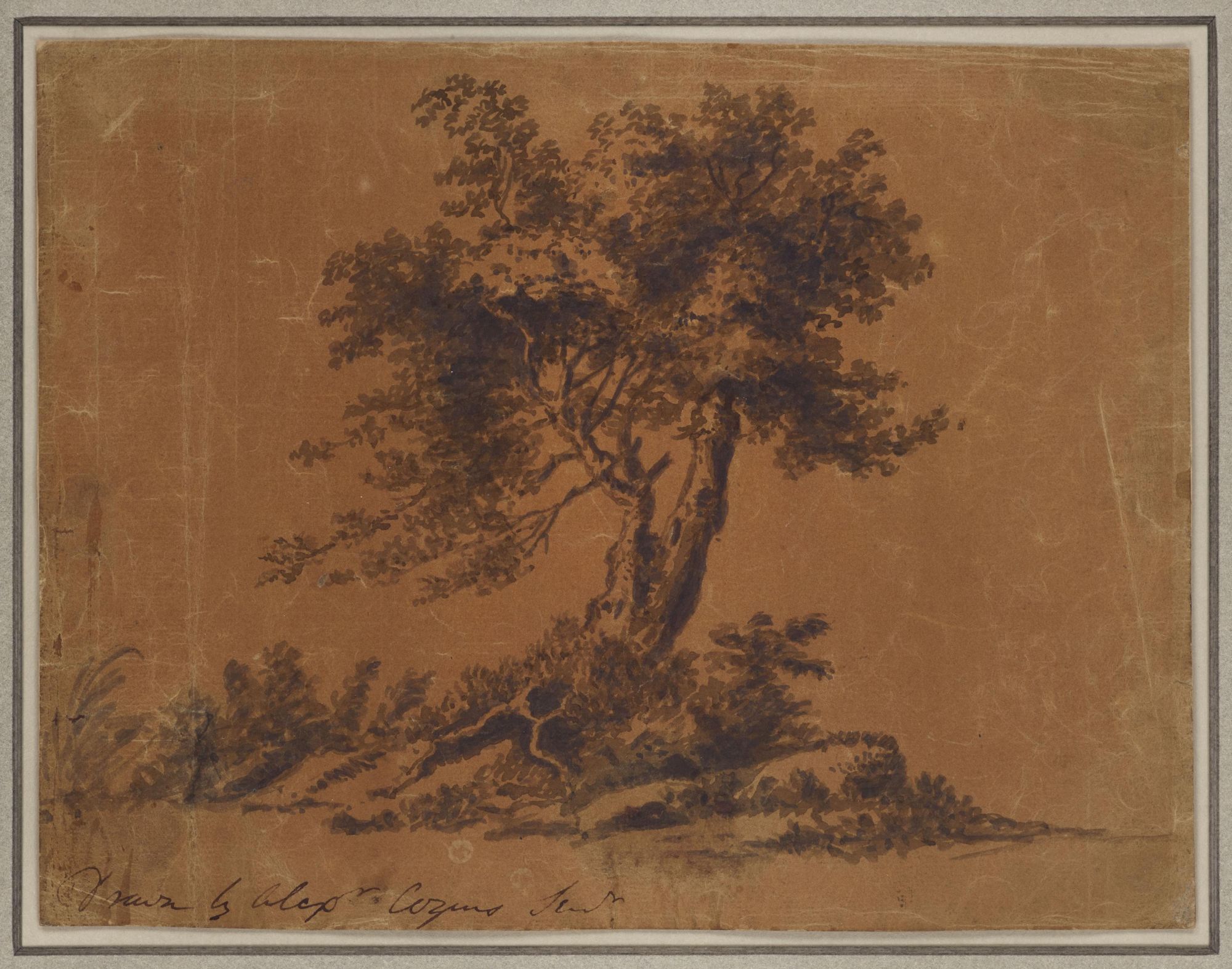
Tree Study
Tree StudyInscribed lower left: Drawn by Alexr Cozens SenrGrey wash on prepared laid paper19.5 by 25.5 cm., 7 ½ by 10 in.Provenance: Anonymous sale, Sotheby's London, 2nd May 1962, lot 29, bt. Spink for £40; Stanhope Shelton (1908-1983);Raymond Lister (1919-2001); Private collection, LondonCozens was highly regarded not only as an artist but, almost more importantly, as an educator and thinker on art. Following his return from Italy in circa 1749, he took up a teaching post at Christ's Hospital, a position he held for four years. He was later appointed drawing master at Eton College (which he held for twenty years) and where he taught and influenced generations of collectors and amateurs, including Sir George Beaumont. He also establishing a flourishing private practice including the Royal princes. Throughout his life he formulated and developed methods to help both professional and amateur artists, which he disseminated more widely through the publication of several treatises including, The Principals of Beauty relative to the Human Head, 1778 and A New Method of Assisting the Invention on Drawing Original Compositions of Landscape, 1786. This varied practice enabled him to shape the artistic practices and collecting ideas of a generation of patrons and collectors including William Beckford, Viscount Nuneham (later 2nd Earl Harcourt) and his sister Lady Elizabeth Lee. He also profoundly influenced professional artists, both contemporary and younger emerging artists, including Joseph Wright of Derby, Thomas Gainsborough, John Constable, J.M.W. Turner, Thomas Girtin, George Romney and his own son John Robert Cozens. Cozens was fascinated by composition, tone, light and shadow, form and shape and partly in order to enable him to explore these ideas, and partly possible the result of his training as an engraver, the artist abandoned colour almost completely in his drawing. The present drawing demonstrates the artist's fascination with trees, not merely as generic staffage for his landscapes, but as worthy of subjects in their own right and is grounded firmly in direct observation of the natural world. Although Cozens further employed such observations in his landscapes of the imagination, thus weaving entirely imaginary compositions into reality. In 1771, he published The Shape, Skeleton and Foliage of Thirty Two Species of Trees for the Use of Painting and Drawing. As Rhian Addison notes, 'Alexander's etching knowledge allowed him to translate the various species of trees from pencil, ink and watercolour to a metal plate for Thirty Two Species of Trees. In turn, Alexander was able to disseminate his knowledge and methods to a far greater audience than those in academia. Trees were a single factor in a multitude of elements that Alexander studied, formulated and published. They are, however, the single most common factor in his landscapes, projecting the emotion of the scene to through composition, weight and movement'. (Rhian Addison, The Educators of Trees: Alexander and John Robert Cozens, Manchester, 2017, p.3 (https://documents.manchester.ac.uk/display.aspx?DocID=32832).)
Alexander Cozens (1717-1786)
Tree Study
Inscribed lower left: Drawn by Alexr Cozens Senr
Grey wash on prepared laid paper
19.5 by 25.5 cm., 7 ½ by 10 in.
Provenance:
Anonymous sale, Sotheby's London, 2nd May 1962, lot 29, bt. Spink for £40;
Stanhope Shelton (1908-1983);
Raymond Lister (1919-2001);
Private collection, London
Cozens was highly regarded not only as an artist but, almost more importantly, as an educator and thinker on art. Following his return from Italy in circa 1749, he took up a teaching post at Christ's Hospital, a position he held for four years. He was later appointed drawing master at Eton College (which he held for twenty years) and where he taught and influenced generations of collectors and amateurs, including Sir George Beaumont. He also establishing a flourishing private practice including the Royal princes. Throughout his life he formulated and developed methods to help both professional and amateur artists, which he disseminated more widely through the publication of several treatises including, The Principals of Beauty relative to the Human Head, 1778 and A New Method of Assisting the Invention on Drawing Original Compositions of Landscape, 1786.
This varied practice enabled him to shape the artistic practices and collecting ideas of a generation of patrons and collectors including William Beckford, Viscount Nuneham (later 2nd Earl Harcourt) and his sister Lady Elizabeth Lee. He also profoundly influenced professional artists, both contemporary and younger emerging artists, including Joseph Wright of Derby, Thomas Gainsborough, John Constable, J.M.W. Turner, Thomas Girtin, George Romney and his own son John Robert Cozens.
Cozens was fascinated by composition, tone, light and shadow, form and shape and partly in order to enable him to explore these ideas, and partly possible the result of his training as an engraver, the artist abandoned colour almost completely in his drawing.
The present drawing demonstrates the artist's fascination with trees, not merely as generic staffage for his landscapes, but as worthy of subjects in their own right and is grounded firmly in direct observation of the natural world. Although Cozens further employed such observations in his landscapes of the imagination, thus weaving entirely imaginary compositions into reality. In 1771, he published The Shape, Skeleton and Foliage of Thirty Two Species of Trees for the Use of Painting and Drawing. As Rhian Addison notes, 'Alexander's etching knowledge allowed him to translate the various species of trees from pencil, ink and watercolour to a metal plate for Thirty Two Species of Trees. In turn, Alexander was able to disseminate his knowledge and methods to a far greater audience than those in academia. Trees were a single factor in a multitude of elements that Alexander studied, formulated and published. They are, however, the single most common factor in his landscapes, projecting the emotion of the scene to through composition, weight and movement'. (Rhian Addison, The Educators of Trees: Alexander and John Robert Cozens, Manchester, 2017, p.3 (https://documents.manchester.ac.uk/display.aspx?DocID=32832).