
The City of Kandy and Temple containing the Sacred Relic, Buddha's Tooth, Sri Lanka
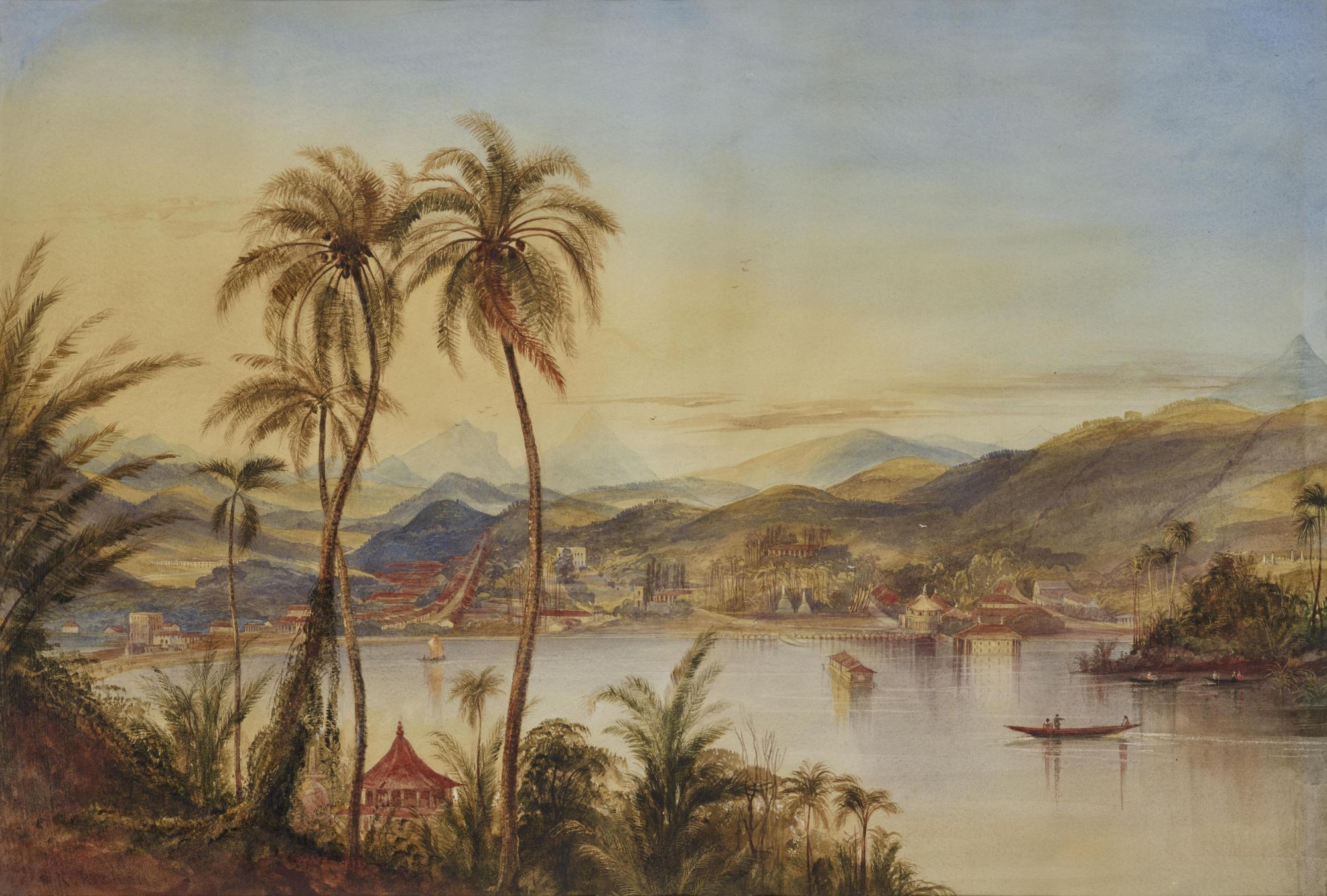
The City of Kandy and Temple containing the Sacred Relic, Buddha's Tooth, Sri Lanka
The City of Kandy and Temple containing the Sacred Relic, Buddha's Tooth, Sri LankaSigned lower left: A. Nicholl and inscribed with title verso Watercolour over pencil heightened with bodycolour stopping out on wove paper watermarked: J Whatman/Turkey Mill47 by 69.5 cm., 18 ½ by 27 ½ in.Provenance: The Albany Gallery, London;Private collection since the 1980sOne of Nicholl's key patrons in Ireland, Sir James Emerson Tennent (1804-1869) was the Colonial Secretary in Ceylon between 1845 and 1850. He appointed Nicholl to teach landscape, painting, scientific drawing and design at the Colombo Academy. Nicholl left for the Island in August 1846 and remained there until 1849 or 50. In July 1848, Nicholl travelled with with a small party from Colombo to Kandy to meet up with Emerson Tennent and the botanist George Gardner (1810-1849), with whom he was going to tour the rest of the Island. Kandy was an ancient kingdom in the centre of the Island and was the stronghold for resistance against the Portuguese, Dutch and the British. In 1852, Nicholl published a detailed, poetic and evocative account of his tour of the Island in two parts in vol 40, of the Dublin University Magazine. Nicholls described 'the mountain capital of the kings…situated in an amphitheatre of hills and lofty ranges of rocky and wooded mountains… bounded on the south by a picturesque lake, nearly a mile in length, and about 200 feet in width, encircled by a road which affords a delightful drive and cool air to the European residents' (Andrew Nicholl, 'A Sketching Tour of Fine Weeks in the forest of Ceylon - Its Ruined Temples, Colossal Statues, Tanks, Dagorahs, etc', Dublin University Magazine, vol. 40, 1852, p. 529)The present watercolour depicts Kandy from the opposite side of the lake, which according to Nicholl afforded the 'finest and most picturesque view of Kandy … with its interesting temples, palaces, and dagobahs, embosomed in a thick grove of cocoa palms ; undulating wooded hills, rising in mid-distance, clothed with coffee bushes from base to summit, and bounded by the Kadagonava range' (ibid.). The building below the two palm trees, is the Sri Dalada Maligawa and houses the holy relic of the tooth of the Buddha, which was apparently brought to Sri Lanka in the 4th Century. It proved an eventful tour, as Nicholl, who had stayed behind the rest of the party at Arandhapoora, to sketch the ruins there, was travelling back to Kandy, when he met a group fleeing an uprising, where a rebel king had been crowned. Nicholl fled back to where he came from, pursued by supporters of the rebel king and returned to Colombo by boat. Despite the dramatic ending, Nicholl regarded the trip as 'the most interesting I ever had in my life, and though attended with both danger and fatigue, yet the enjoyment which I derived from it far more compensated for the hardship of the journey, and will ever be considered by me the most delightful of all my sketching excursions, either at home or in distant lands' (op. cit, p.700). Emerson Tennent published a two-volume account of Ceylon, which is still regarded as an authoritative work on the history and geography of the Island. Nicholl provided several illustrations for the publication and also exhibited several paintings of the country at the Royal Academy between 1849 and 1854.)
Andrew Nicholl R.H.A. (1804-1886)
The City of Kandy and Temple containing the Sacred Relic, Buddha's Tooth, Sri Lanka
Signed lower left: A. Nicholl and inscribed with title verso
Watercolour over pencil heightened with bodycolour stopping out on wove paper watermarked: J Whatman/Turkey Mill
47 by 69.5 cm., 18 ½ by 27 ½ in.
Provenance:
The Albany Gallery, London;
Private collection since the 1980s
One of Nicholl's key patrons in Ireland, Sir James Emerson Tennent (1804-1869) was the Colonial Secretary in Ceylon between 1845 and 1850. He appointed Nicholl to teach landscape, painting, scientific drawing and design at the Colombo Academy. Nicholl left for the Island in August 1846 and remained there until 1849 or 50.
In July 1848, Nicholl travelled with with a small party from Colombo to Kandy to meet up with Emerson Tennent and the botanist George Gardner (1810-1849), with whom he was going to tour the rest of the Island. Kandy was an ancient kingdom in the centre of the Island and was the stronghold for resistance against the Portuguese, Dutch and the British. In 1852, Nicholl published a detailed, poetic and evocative account of his tour of the Island in two parts in vol 40, of the Dublin University Magazine. Nicholls described 'the mountain capital of the kings…situated in an amphitheatre of hills and lofty ranges of rocky and wooded mountains… bounded on the south by a picturesque lake, nearly a mile in length, and about 200 feet in width, encircled by a road which affords a delightful drive and cool air to the European residents' (Andrew Nicholl, 'A Sketching Tour of Fine Weeks in the forest of Ceylon - Its Ruined Temples, Colossal Statues, Tanks, Dagorahs, etc', Dublin University Magazine, vol. 40, 1852, p. 529)
The present watercolour depicts Kandy from the opposite side of the lake, which according to Nicholl afforded the 'finest and most picturesque view of Kandy … with its interesting temples, palaces, and dagobahs, embosomed in a thick grove of cocoa palms ; undulating wooded hills, rising in mid-distance, clothed with coffee bushes from base to summit, and bounded by the Kadagonava range' (ibid.). The building below the two palm trees, is the Sri Dalada Maligawa and houses the holy relic of the tooth of the Buddha, which was apparently brought to Sri Lanka in the 4th Century.
It proved an eventful tour, as Nicholl, who had stayed behind the rest of the party at Arandhapoora, to sketch the ruins there, was travelling back to Kandy, when he met a group fleeing an uprising, where a rebel king had been crowned. Nicholl fled back to where he came from, pursued by supporters of the rebel king and returned to Colombo by boat. Despite the dramatic ending, Nicholl regarded the trip as 'the most interesting I ever had in my life, and though attended with both danger and fatigue, yet the enjoyment which I derived from it far more compensated for the hardship of the journey, and will ever be considered by me the most delightful of all my sketching excursions, either at home or in distant lands' (op. cit, p.700). Emerson Tennent published a two-volume account of Ceylon, which is still regarded as an authoritative work on the history and geography of the Island. Nicholl provided several illustrations for the publication and also exhibited several paintings of the country at the Royal Academy between 1849 and 1854.