
The Falls of Kalama, Albania
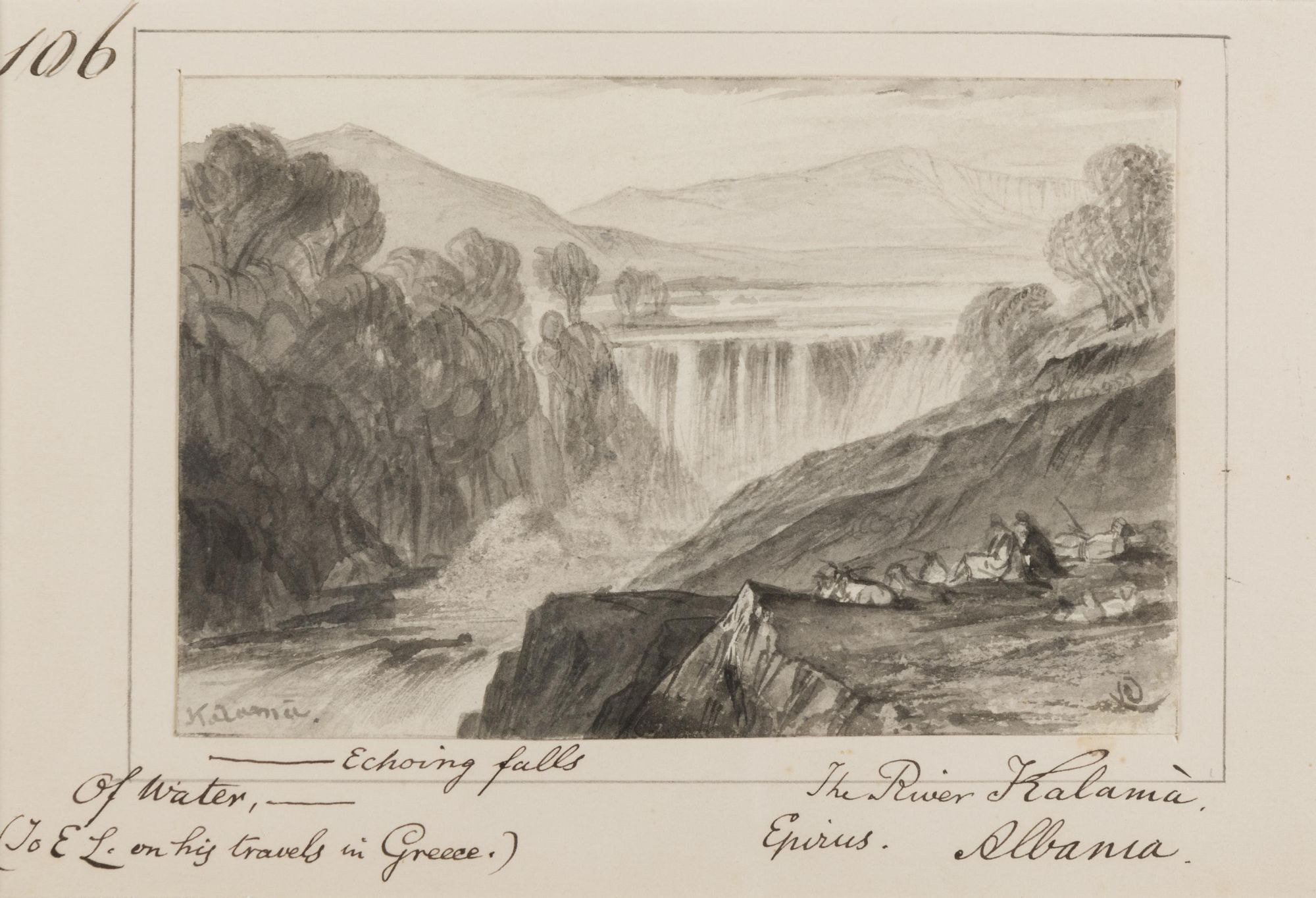
The Falls of Kalama, Albania
The Falls of Kalama, AlbaniaSigned with artist's monogram (lower right) and inscribed Kalama (lower left). Further inscribed on mount - Echoing falls/Of Water,-/(To E.L. on his travels in Greece.) and The River Kalama,/ Epirus. Albania and numbered 106Grey wash with touches of scratching out9.6 by 14.6 cm., 3 ¾ by 5 ¾ in. Provenance: The Tennyson Family;Tennyson Research Centre, Lincoln until 1980;With Thos. Agnew & Sons (no. 47321);Private CollectionLiterature: Ruth Pitman, Edward Lear's Tennyson, 1988, pp. 141, 145, illust. p. 143 Lear had long been an admirer of the work of Alfred, Lord Tennyson (1809 - 1892). Following an introduction by their mutual friend Franklin Lushington in 1850 (whose brother was married to Tennyson's sister Cecilia), Lear sent the Tennysons a belated wedding present of his illustrated Journals of a Landscape Painter in Albania &c. In response, a little later in 1853, Tennyson wrote a poem entitled To E.L. on his travels in Greece. Their admiration for each other's work developed into friendship (which at times proved tempestuous) and a regular correspondence. Lear was always slightly in awe of the Poet Laureate and sometimes found him a daunting character, however, his admiration for the man as a poet remained undiminished. Lear was a regular visitor to Farringford, the Tennyson's family home on the Isle of Wight and became especially close to Tennyson's wife, Emily who he described 'as 10000 angels boiled down - an essence of goodness' (Lear, Edward, 1812-1888. Diary: autograph manuscript, 1872., 1872.. Edward Lear diaries, MS Eng 797.3, (15), and their sons, Hallam and Lionel. Emily proved a great source of comfort and advice to Lear, throughout his later years, when he struggled emotionally, physically and financially. When Lear moved to San Remo in the 1870s, he named his house Villa Tennyson. In 1852, whilst staying with Holman Hunt at Clive Vale Farm, Lear's long-held ambition of producing illustrations for some of Tennyson's poems began to take form. He decided that was to create a series of landscapes, intended as a tribute to the poet and his keen perception of landscape and to use the poem 'To EL.' as the centrepiece. His intention was to take a line, or lines, from a poem and to illustrate them with landscapes from his various journeys that he felt related directly to those lines, rather than the poem as a whole. Lear wrote to Emily in October 1852, setting out his ideas and he worked at the project on and off from then onwards. The scheme evolved through a mixture of a small group of oils, accompanied by a larger group of watercolours, through experimenting with different formats and sizes, until by the last few years of his life, he settled on working in monochrome. He worked up groups of drawings in both brown ink and wash, and grey wash, as well as grey wash with brown ink or pencil or black highlights. Over the decades, these works became, deeply personal to the artist, allowing him to give full reign to his striving for 'poetical topography… and finally, to his idea of a record of his own artistic endeavour' (R. Pitman, Edward Lear's Tennyson, 1988, p. 28). However, it was not until after his death that 36 of his proposed works were reproduced in a special edition of Tennyson's poetry published in 1889 in honour of Lear. The present drawings relate to Tennyson's To E.L. on his travels in Greece, published 1853. Lear was one of the few British artists to visit Albania in the mid 19th century. He wrote: `You have that which is found neither in Greece nor in Italy, a profusion everywhere of the most magnificent foliage recalling the greenness of our own island… You have majestic cliff-girt shores; castle-crowned heights, and gloomy forests; palaces glittering with gilding and paint; mountain passes such as you encounter in the snowy regions in Switzerland… and with all this a crowded variety of costume and pictorial incident such as bewilders and delights an artist at each step he takes (quoted in Vivien Noakes, The Painter Edward Lear, 1991, p.52). Lear described the falls of Kalama as 'perhaps one of the prettiest points in the morning's ride... which not even the incessant drizzle of sleet with bitter wind could prevent my admiring' (E. Lear, Journals of a landscape Painter in Albania &c., 1851, p. 325). The Kalama river runs partly along the border between Albania and Greece. A finished watercolour version of this view by Lear was sold at Christie's on 15th December 2010, 68.)
Edward Lear (1812-1888)
The Falls of Kalama, Albania
Signed with artist's monogram (lower right) and inscribed Kalama (lower left). Further inscribed on mount - Echoing falls/Of Water,-/(To E.L. on his travels in Greece.) and The River Kalama,/ Epirus. Albania and numbered 106
Grey wash with touches of scratching out
9.6 by 14.6 cm., 3 ¾ by 5 ¾ in.
Provenance:
The Tennyson Family;
Tennyson Research Centre, Lincoln until 1980;
With Thos. Agnew & Sons (no. 47321);
Private Collection
Literature:
Ruth Pitman, Edward Lear's Tennyson, 1988, pp. 141, 145, illust. p. 143
Lear had long been an admirer of the work of Alfred, Lord Tennyson (1809 - 1892). Following an introduction by their mutual friend Franklin Lushington in 1850 (whose brother was married to Tennyson's sister Cecilia), Lear sent the Tennysons a belated wedding present of his illustrated Journals of a Landscape Painter in Albania &c. In response, a little later in 1853, Tennyson wrote a poem entitled To E.L. on his travels in Greece. Their admiration for each other's work developed into friendship (which at times proved tempestuous) and a regular correspondence. Lear was always slightly in awe of the Poet Laureate and sometimes found him a daunting character, however, his admiration for the man as a poet remained undiminished.
Lear was a regular visitor to Farringford, the Tennyson's family home on the Isle of Wight and became especially close to Tennyson's wife, Emily who he described 'as 10000 angels boiled down - an essence of goodness' (Lear, Edward, 1812-1888. Diary: autograph manuscript, 1872., 1872.. Edward Lear diaries, MS Eng 797.3, (15), and their sons, Hallam and Lionel. Emily proved a great source of comfort and advice to Lear, throughout his later years, when he struggled emotionally, physically and financially. When Lear moved to San Remo in the 1870s, he named his house Villa Tennyson.
In 1852, whilst staying with Holman Hunt at Clive Vale Farm, Lear's long-held ambition of producing illustrations for some of Tennyson's poems began to take form. He decided that was to create a series of landscapes, intended as a tribute to the poet and his keen perception of landscape and to use the poem 'To EL.' as the centrepiece. His intention was to take a line, or lines, from a poem and to illustrate them with landscapes from his various journeys that he felt related directly to those lines, rather than the poem as a whole.
Lear wrote to Emily in October 1852, setting out his ideas and he worked at the project on and off from then onwards. The scheme evolved through a mixture of a small group of oils, accompanied by a larger group of watercolours, through experimenting with different formats and sizes, until by the last few years of his life, he settled on working in monochrome. He worked up groups of drawings in both brown ink and wash, and grey wash, as well as grey wash with brown ink or pencil or black highlights. Over the decades, these works became, deeply personal to the artist, allowing him to give full reign to his striving for 'poetical topography… and finally, to his idea of a record of his own artistic endeavour' (R. Pitman, Edward Lear's Tennyson, 1988, p. 28). However, it was not until after his death that 36 of his proposed works were reproduced in a special edition of Tennyson's poetry published in 1889 in honour of Lear. The present drawings relate to Tennyson's To E.L. on his travels in Greece, published 1853.
Lear was one of the few British artists to visit Albania in the mid 19th century. He wrote: `You have that which is found neither in Greece nor in Italy, a profusion everywhere of the most magnificent foliage recalling the greenness of our own island… You have majestic cliff-girt shores; castle-crowned heights, and gloomy forests; palaces glittering with gilding and paint; mountain passes such as you encounter in the snowy regions in Switzerland… and with all this a crowded variety of costume and pictorial incident such as bewilders and delights an artist at each step he takes (quoted in Vivien Noakes, The Painter Edward Lear, 1991, p.52). Lear described the falls of Kalama as 'perhaps one of the prettiest points in the morning's ride... which not even the incessant drizzle of sleet with bitter wind could prevent my admiring' (E. Lear, Journals of a landscape Painter in Albania &c., 1851, p. 325). The Kalama river runs partly along the border between Albania and Greece. A finished watercolour version of this view by Lear was sold at Christie's on 15th December 2010, 68.