
The Café de l'Amitié and l'Ancient Hôtel of Prince Frederick, Brussels
The Café de l'Amitié and l'Ancient Hôtel of Prince Frederick, Brussels
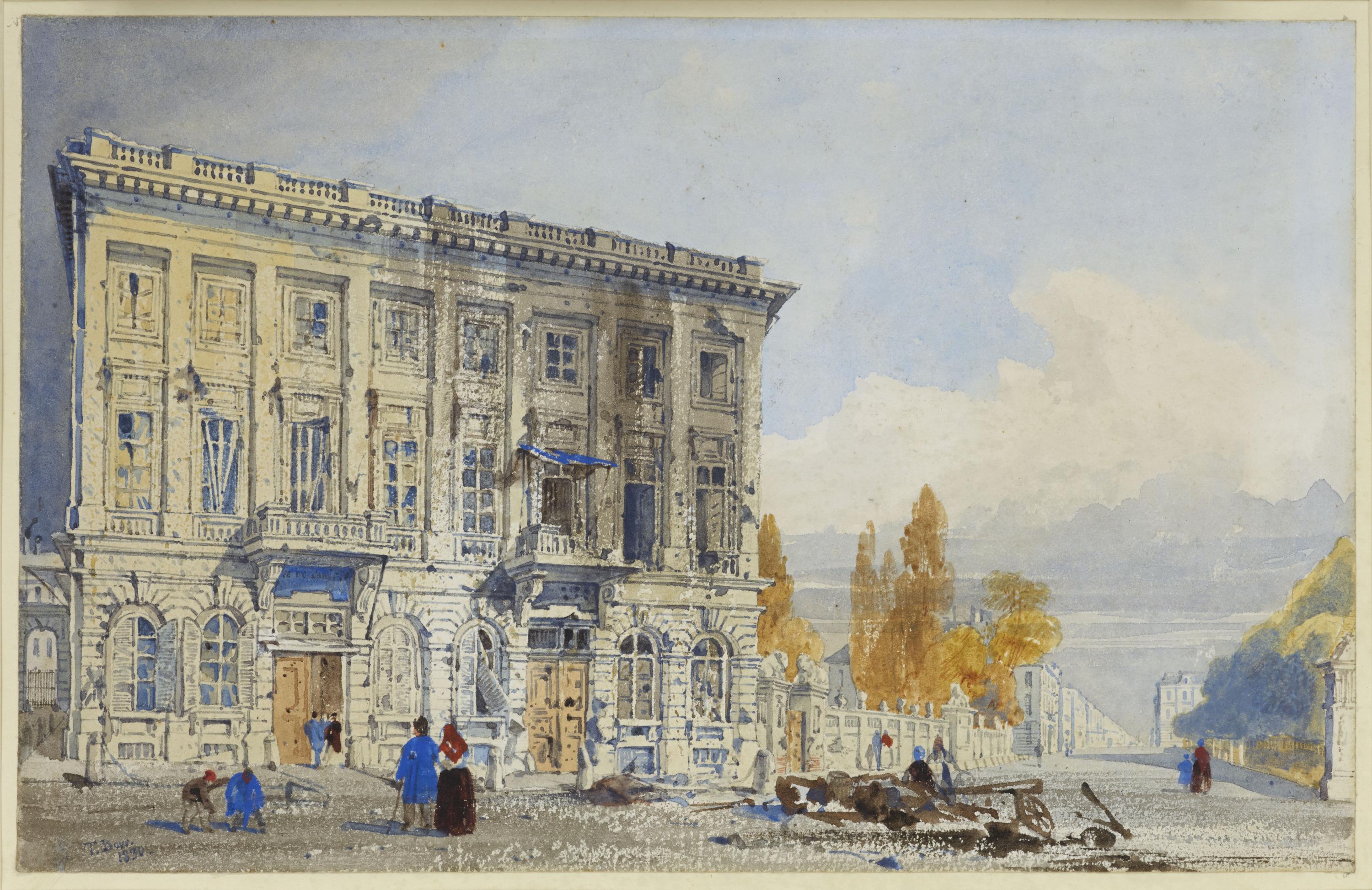
The Café de l'Amitié and l'Ancient Hôtel of Prince Frederick, BrusselsSigned and dated, lower left: T. Boys./1830Watercolour heightened with bodycolour over touches of pencil15.7 by 24.6 cm, 6 ¼ by 9 ¾ in. Provenance: Anonymous sale, Christie's, London, 10th July 2014, lot 207, where bought by the present owner; Private collection, LondonDuring the early 1830s, Boys travelled round Europe gathering material for his Picturesque Architecture in Paris, Ghent, Rouen, etc. which was published in 1839. He was in Belgium during the late summer of 1830, when he got caught up in the short-lived but successful Belgian Revolution. Following the end of the Napoleonic Wars, the Northern and Southern Netherlands (Belgium and Holland respectively) were united into a single state, at the Congress of Vienna in 1815. However, the different factions within the state were unhappy: the Catholics resented interference from the Protestant king, William I, in clerical matters and the liberals wanted greater freedom. The factions united and revolution erupted in Brussels. Initially William I sent in his troops, but on 27th September 1830, following four days of heavy fighting, the troops were driven out of the city. As a result, the Northern Netherlands separated and a Provisional Government declared independence on 4th October. The following year, Leopold I of Saxe-Coburg was offered the crown as King of the Belgians and in early November, a diplomatic conference was held where the Belgium state was officially recognised by the other major European states.The Café de L' Amitié was the main meeting place for politicians, writers and artists in Brussels at the time and adjoining it was Prince Frederick's palace. It became the target for the Netherlands military and was badly damaged during the conflict, as evidenced in the present watercolour, with the obviously pitted stonework and shattered features and the remains of a carriage in the foreground. However, Boys has contrasted the devastation with the calmness of the view down the road to the right and the figures engaged in daily activity. Boys painted several views of Brussels at this time, but few reflect the turmoil which must have surrounded the artist during the brief conflict. There is a another watercolour of the Hotel de Bellevue and the Café de l'Amitié seen from the Park, (see James Roundell, Thomas Shotter Boys, 1974, pp.76-7, plate 14) which also bears testament to the recent uprising, although in the latter it is only really hinted at with the inclusion of a cannon and some slight damage to one of the buildings.)
Thomas Shotter Boys, O.W.S. (1803-1874)
The Café de l'Amitié and l'Ancient Hôtel of Prince Frederick, Brussels
Signed and dated, lower left: T. Boys./1830
Watercolour heightened with bodycolour over touches of pencil
15.7 by 24.6 cm, 6 ¼ by 9 ¾ in.
Provenance:
Anonymous sale, Christie's, London, 10th July 2014, lot 207, where bought by the present owner;
Private collection, London
During the early 1830s, Boys travelled round Europe gathering material for his Picturesque Architecture in Paris, Ghent, Rouen, etc. which was published in 1839. He was in Belgium during the late summer of 1830, when he got caught up in the short-lived but successful Belgian Revolution. Following the end of the Napoleonic Wars, the Northern and Southern Netherlands (Belgium and Holland respectively) were united into a single state, at the Congress of Vienna in 1815. However, the different factions within the state were unhappy: the Catholics resented interference from the Protestant king, William I, in clerical matters and the liberals wanted greater freedom. The factions united and revolution erupted in Brussels. Initially William I sent in his troops, but on 27th September 1830, following four days of heavy fighting, the troops were driven out of the city. As a result, the Northern Netherlands separated and a Provisional Government declared independence on 4th October. The following year, Leopold I of Saxe-Coburg was offered the crown as King of the Belgians and in early November, a diplomatic conference was held where the Belgium state was officially recognised by the other major European states.
The Café de L' Amitié was the main meeting place for politicians, writers and artists in Brussels at the time and adjoining it was Prince Frederick's palace. It became the target for the Netherlands military and was badly damaged during the conflict, as evidenced in the present watercolour, with the obviously pitted stonework and shattered features and the remains of a carriage in the foreground. However, Boys has contrasted the devastation with the calmness of the view down the road to the right and the figures engaged in daily activity.
Boys painted several views of Brussels at this time, but few reflect the turmoil which must have surrounded the artist during the brief conflict. There is a another watercolour of the Hotel de Bellevue and the Café de l'Amitié seen from the Park, (see James Roundell, Thomas Shotter Boys, 1974, pp.76-7, plate 14) which also bears testament to the recent uprising, although in the latter it is only really hinted at with the inclusion of a cannon and some slight damage to one of the buildings.