
Derwentwater, Lake District
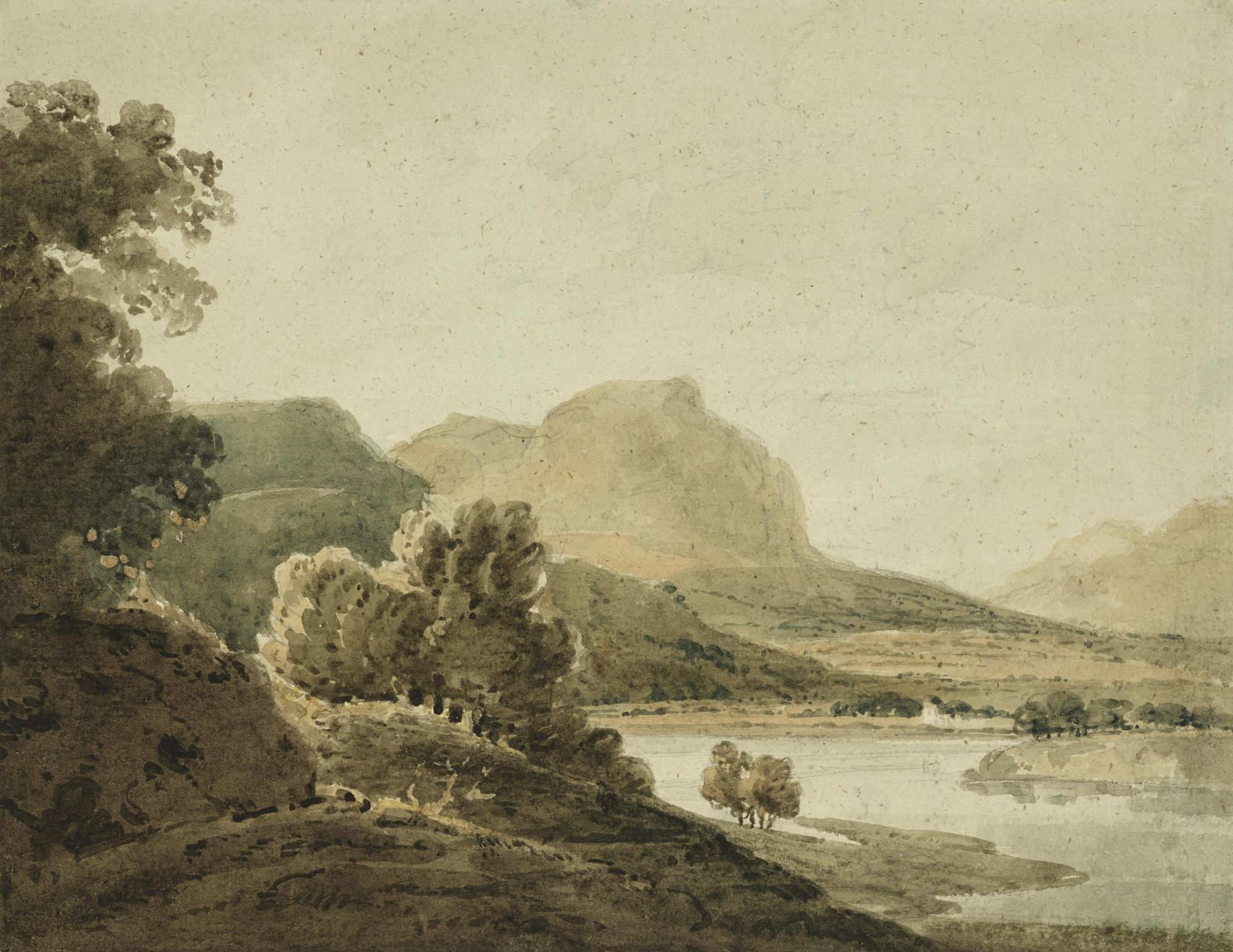
Derwentwater, Lake District
Derwentwater, Lake DistrictWatercolour over pencil 23.9 by 30.7 cm., 9 ¼ by 12 in.Provenance: Sir George Howland Beaumont, Bt. (1753-1827);By descent to Sir George Howland Francis Beaumont, 12th Baronet (1924-2011), 1949;David Eccles, 1st Viscount Eccles (1904-1999); With P. & D. Colnaghi & Co Ltd, 1979; Anonymous sale, Christie's, 15th June 1982, lot 39; Anonymous sale, Christie's 15th November 1983, lot 167;By descent to the present ownerLiterature: T. Girtin and D. Loshak, The Art of Thomas Girtin, 1954, no. 316;Luke Herrmann and Felicity Owen, "… a painter's eye, a poet's heart": Sir George Beaumont of Coleorton, exhibition catalogue, Leicester Museum and Art Gallery, 1973, p. 47;Greg Smith, Thomas Girtin (1775-1802): An Online Catalogue, Archive and Introduction to the Artist, (London: Paul Mellon Centre for Studies in British Art, 2022), https://doi.org/10.17658/girtin/TG1585Exhibited: London, P. & D. Colnaghi & Co. Ltd, A Loan Exhibition of English Drawings and Watercolours in Memory of the Late D. C. T. Baskett, 30th July to 23rd August 1963, no. 39;London, P. & D. Colnaghi, English Drawings and Watercolours, 15th November to 20th December 1979, no. 57The present watercolour depicts the east shore of Derwentwater, with the Lodore Falls about halfway along and Borrowdale in the centre. Greg Smith notes that the watercolour is one of eight works of varying sizes that Girtin executed for Sir George Beaumont, based on the amateur's own on-the-spot small, monochrome sketches which he had produced during the summer of 1798. Beaumont's sketches were once gathered in a volume of drawings entitled Environs of Keswick. Girtin and Loshak (op. cit.) state that the present watercolour, along with three others that they had identified by 1951, all depict Lake District views. The other three capture Grange Bridge, Borrowdale, Keswick and Culloth Force, Cumberland and are all dated between June and September 1789.Smith suggests that the group of watercolours were perhaps produced by Girtin as part of a lesson for the amateur artist and were created at Coleorton in late 1798-9. As such these were a continuation of the work he was producing a few years earlier for Dr Thomas Monro (1759-1833) and James Moore (1762-1799). However they were neither straightforward, literal copies of the amateur artist's work, nor a working up into a highly finished watercolour from a rapid outline sketch (as Girtin had done for Moore). Rather they were larger, freer interpretations, in which the artist made changes to the balance and emphasis of the original subjects, in order to demonstrate different effects and techniques to his patron. As Smith noted, 'there may also have been a performative element…since we might expect the amateur to have watched their progress with instruction in mind' (p. 161). Furthermore, this group of watercolours had a profound impact on the colour studies that John Constable produced during his tour to the Lake District in the autumn of 1806. As Ian Fleming-Williams noted (Constable and his Drawings, 1990, pp. 88-88), Constable turned to Girtin's work for inspiration in dealing with unfamiliar mountain subjects, and in how watercolour might be used on-the-spot, in order to effectively capture the monumentality of a subject and to convey a sense of space.)
Thomas Girtin (1775-1802)
Derwentwater, Lake District
Watercolour over pencil
23.9 by 30.7 cm., 9 ¼ by 12 in.
Provenance:
Sir George Howland Beaumont, Bt. (1753-1827);
By descent to Sir George Howland Francis Beaumont, 12th Baronet (1924-2011), 1949;
David Eccles, 1st Viscount Eccles (1904-1999);
With P. & D. Colnaghi & Co Ltd, 1979;
Anonymous sale, Christie's, 15th June 1982, lot 39;
Anonymous sale, Christie's 15th November 1983, lot 167;
By descent to the present owner
Literature:
T. Girtin and D. Loshak, The Art of Thomas Girtin, 1954, no. 316;
Luke Herrmann and Felicity Owen, "… a painter's eye, a poet's heart": Sir George Beaumont of Coleorton, exhibition catalogue, Leicester Museum and Art Gallery, 1973, p. 47;
Greg Smith, Thomas Girtin (1775-1802): An Online Catalogue, Archive and Introduction to the Artist, (London: Paul Mellon Centre for Studies in British Art, 2022), https://doi.org/10.17658/girtin/TG1585
Exhibited:
London, P. & D. Colnaghi & Co. Ltd, A Loan Exhibition of English Drawings and Watercolours in Memory of the Late D. C. T. Baskett, 30th July to 23rd August 1963, no. 39;
London, P. & D. Colnaghi, English Drawings and Watercolours, 15th November to 20th December 1979, no. 57
The present watercolour depicts the east shore of Derwentwater, with the Lodore Falls about halfway along and Borrowdale in the centre. Greg Smith notes that the watercolour is one of eight works of varying sizes that Girtin executed for Sir George Beaumont, based on the amateur's own on-the-spot small, monochrome sketches which he had produced during the summer of 1798.
Beaumont's sketches were once gathered in a volume of drawings entitled Environs of Keswick. Girtin and Loshak (op. cit.) state that the present watercolour, along with three others that they had identified by 1951, all depict Lake District views. The other three capture Grange Bridge, Borrowdale, Keswick and Culloth Force, Cumberland and are all dated between June and September 1789.
Smith suggests that the group of watercolours were perhaps produced by Girtin as part of a lesson for the amateur artist and were created at Coleorton in late 1798-9. As such these were a continuation of the work he was producing a few years earlier for Dr Thomas Monro (1759-1833) and James Moore (1762-1799). However they were neither straightforward, literal copies of the amateur artist's work, nor a working up into a highly finished watercolour from a rapid outline sketch (as Girtin had done for Moore). Rather they were larger, freer interpretations, in which the artist made changes to the balance and emphasis of the original subjects, in order to demonstrate different effects and techniques to his patron. As Smith noted, 'there may also have been a performative element…since we might expect the amateur to have watched their progress with instruction in mind' (p. 161).
Furthermore, this group of watercolours had a profound impact on the colour studies that John Constable produced during his tour to the Lake District in the autumn of 1806. As Ian Fleming-Williams noted (Constable and his Drawings, 1990, pp. 88-88), Constable turned to Girtin's work for inspiration in dealing with unfamiliar mountain subjects, and in how watercolour might be used on-the-spot, in order to effectively capture the monumentality of a subject and to convey a sense of space.