
At Lewknor, Oxfordshire
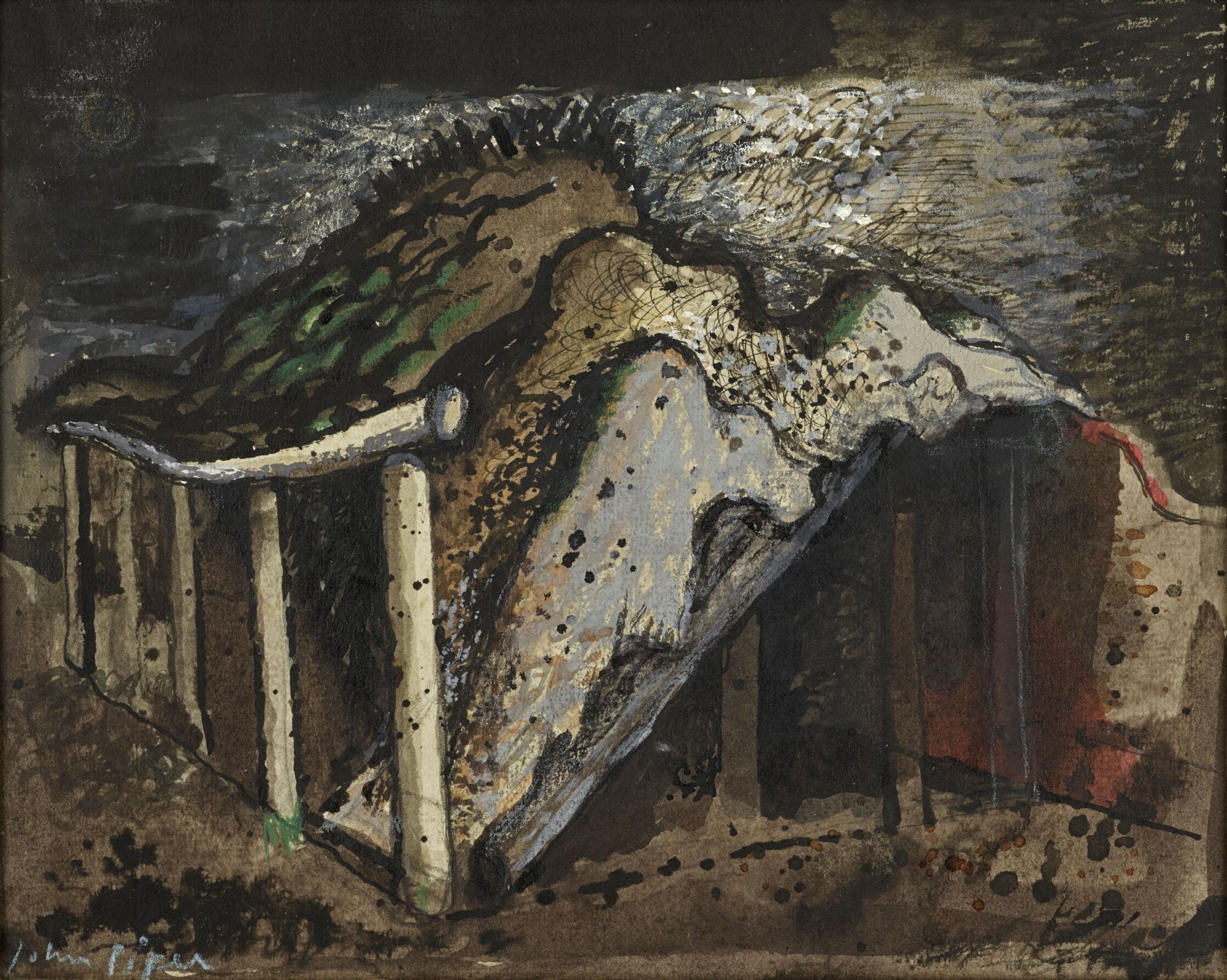
At Lewknor, Oxfordshire
At Lewknor, OxfordshireSigned lower left: John PiperPen and ink and watercolour Sheet size: 20.4 by 26 cm., 8 by 10 ¼ in.Image size: 17.6 by 22.2 cm., 7 by 8 ¾ in.Provenance: Graham Slater (1927-2024)Engraved:By the artist as a lithograph for `English, Scottish and Welsh Landscape', 1944, pl.V, facing p.43Piper travelled extensively throughout Britain and abroad in search of suitable landscape and architectural subjects. However, he found much inspiration in his beloved Oxfordshire. In 1935, the artist moved to Fawley Bottom, near Henley-on-Thames and remained there until his death in 1992. Lewknor lies at the foot of the Chilterns, about five miles south of Thame. Piper was particularly fascinated by buildings that had fallen into a state of disrepair, as Frances Spalding noted, 'Piper thought that buildings were like people, they had personalities and characters, and that like people, they should be allowed to both live and die'. (Frances Spalding, John Piper, Myfanwy Piper, Lives in Art, 2009, p.172). The pleasure that the artist found in the forms, textures and shapes of the decaying barn is evident in the characteristically lively ink lines and carefully balanced tones.The present work, which dates from 1944, shows the influence of Samuel Palmer (1805-1881) which is most evident in Piper's monochrome works of the 1940s. Piper was in fact central to championing the rediscovery of the earlier artist's work, which along with William Blake inspired a generation of landscape artists working in the 20th Century, including John Minton, Paul Nash and Graham Sutherland, who were looking for new ways to depict landscape and to convey ideas of spirituality through nature. Such was the power of the artist over the later generation that Sutherland described him as 'a sort of English Van Gogh'. Piper was particularly inspired by Palmer's Shoreham period work, with its intense palette and use of line to create a poetic vision. The mystical qualities inherent on Palmer's work of the period, resonated with Piper's desire to capture a sense of spirituality in his own work. The present work was lithographed by the artist in 1940. Piper later included a view of the church of St Margaret's Lewknor, in his Retrospective of Churches, 1964, as 'Textured Walls, Traceried Windows'.)
John Piper C.H. (1903-1992)
At Lewknor, Oxfordshire
Signed lower left: John Piper
Pen and ink and watercolour
Sheet size: 20.4 by 26 cm., 8 by 10 ¼ in.
Image size: 17.6 by 22.2 cm., 7 by 8 ¾ in.
Provenance:
Graham Slater (1927-2024)
Engraved:
By the artist as a lithograph for `English, Scottish and Welsh Landscape', 1944, pl.V, facing p.43
Piper travelled extensively throughout Britain and abroad in search of suitable landscape and architectural subjects. However, he found much inspiration in his beloved Oxfordshire. In 1935, the artist moved to Fawley Bottom, near Henley-on-Thames and remained there until his death in 1992. Lewknor lies at the foot of the Chilterns, about five miles south of Thame.
Piper was particularly fascinated by buildings that had fallen into a state of disrepair, as Frances Spalding noted, 'Piper thought that buildings were like people, they had personalities and characters, and that like people, they should be allowed to both live and die'. (Frances Spalding, John Piper, Myfanwy Piper, Lives in Art, 2009, p.172). The pleasure that the artist found in the forms, textures and shapes of the decaying barn is evident in the characteristically lively ink lines and carefully balanced tones.
The present work, which dates from 1944, shows the influence of Samuel Palmer (1805-1881) which is most evident in Piper's monochrome works of the 1940s. Piper was in fact central to championing the rediscovery of the earlier artist's work, which along with William Blake inspired a generation of landscape artists working in the 20th Century, including John Minton, Paul Nash and Graham Sutherland, who were looking for new ways to depict landscape and to convey ideas of spirituality through nature. Such was the power of the artist over the later generation that Sutherland described him as 'a sort of English Van Gogh'. Piper was particularly inspired by Palmer's Shoreham period work, with its intense palette and use of line to create a poetic vision. The mystical qualities inherent on Palmer's work of the period, resonated with Piper's desire to capture a sense of spirituality in his own work.
The present work was lithographed by the artist in 1940. Piper later included a view of the church of St Margaret's Lewknor, in his Retrospective of Churches, 1964, as 'Textured Walls, Traceried Windows'.