
A Coastal Landscape
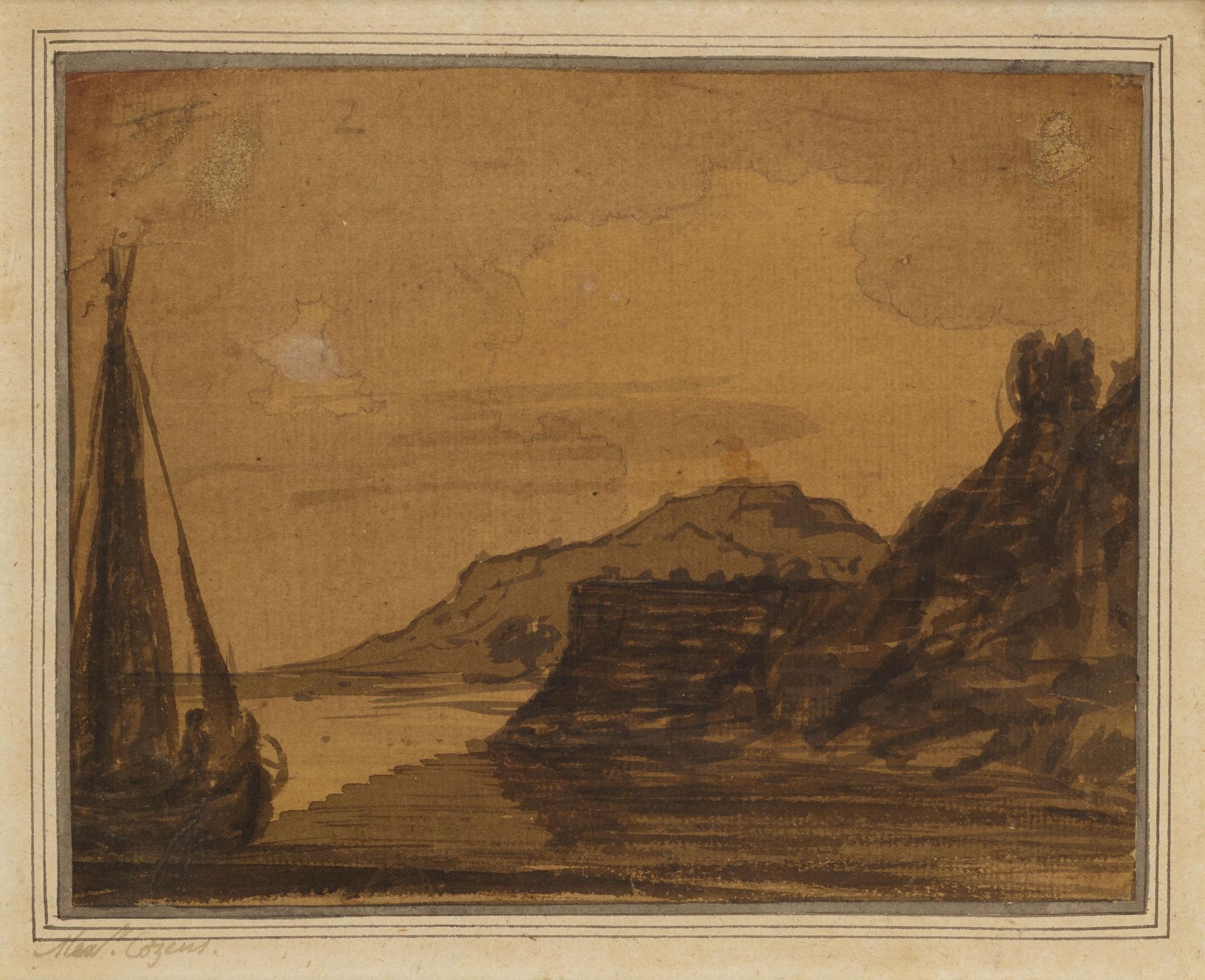
A Coastal Landscape
A Coastal LandscapeSigned lower left, Alexr. Cozens on original mountPencil and grey wash on a prepared ground, with the artist's wash line border13.1 by 16.7 cm, 5 ¼ by 6 ½ in.Provenance: With Spink-Leger Pictures, London, 1999;Christie's, London, 20 November 2003, lot 12;Private collection, LondonExhibited: London, Spink-Leger Pictures, Castles in the Air, Drawings by Alexander Cozens and Victor Hugo, 25th May to 11th June 1999, no. 2Literature: Spink-Leger Pictures, Castles in the Air, Drawings by Alexander Cozens and Victor Hugo, exhibition catalogue, 1999, no. 2The present landscape with steep, rugged cliffs descending into the sea demonstrates the artist's extraordinary ability to transfer onto paper the lively landscapes of his imagination. Cozens was fascinated by scenes like the present landscape as evidenced by several similar subjects of rugged coastal scenes formerly in the Oppé Collection, now Tate Gallery, London. Cozens undertook only one trip outside England, when he went to Italy in 1746 and the surviving sketchbook is filled with depictions of craggy cliffs and mountains, as well as river valleys and decaying classical ruins. Cozens sought not just to capture realistic landscape subjects, rather he wanted to convey emotion through landscape and as such many of his landscapes were of his imagination, conceived as a vehicle for expressing his ideas. His ideas and art place him a key figure in the development of landscape painting in the 18th and early 19th centuries. Of the various systems that Cozens formulated, his most celebrated and influential was his blot technique, where he encouraged his pupils to compose landscapes using ink blots as the basis for a drawing, and then working these up into fully conceived compositions. He first set out his ideas in his Essay to Facilitate the Inventing of Landskip (1759) and expanded these into A New Method of Assisting the Invention in Drawing Original Compositions of Landscape (1786), which not only laid out his theories but contained 16 aquatint plates of blots. He wrote, a 'blot is not a drawing but an assemblage of accidental shapes, from which a drawing might be made…in nature forms are not distinguished by lines, but by shade and colour'. In part, he was inspired by the Renaissance master, Leonardo, who recommended looking at even cracks in a wall, or patterns in stone for inspiration: 'With the swiftest hand make all possible variety of shapes and strokes upon your paper, confining the disposition of the whole to the general form in the example, which you choose for your style of composition'.)
Alexander Cozens (1717-1786)
A Coastal Landscape
Signed lower left, Alexr. Cozens on original mount
Pencil and grey wash on a prepared ground, with the artist's wash line border
13.1 by 16.7 cm, 5 ¼ by 6 ½ in.
Provenance:
With Spink-Leger Pictures, London, 1999;
Christie's, London, 20 November 2003, lot 12;
Private collection, London
Exhibited:
London, Spink-Leger Pictures, Castles in the Air, Drawings by Alexander Cozens and Victor Hugo, 25th May to 11th June 1999, no. 2
Literature:
Spink-Leger Pictures, Castles in the Air, Drawings by Alexander Cozens and Victor Hugo, exhibition catalogue, 1999, no. 2
The present landscape with steep, rugged cliffs descending into the sea demonstrates the artist's extraordinary ability to transfer onto paper the lively landscapes of his imagination. Cozens was fascinated by scenes like the present landscape as evidenced by several similar subjects of rugged coastal scenes formerly in the Oppé Collection, now Tate Gallery, London. Cozens undertook only one trip outside England, when he went to Italy in 1746 and the surviving sketchbook is filled with depictions of craggy cliffs and mountains, as well as river valleys and decaying classical ruins.
Cozens sought not just to capture realistic landscape subjects, rather he wanted to convey emotion through landscape and as such many of his landscapes were of his imagination, conceived as a vehicle for expressing his ideas. His ideas and art place him a key figure in the development of landscape painting in the 18th and early 19th centuries. Of the various systems that Cozens formulated, his most celebrated and influential was his blot technique, where he encouraged his pupils to compose landscapes using ink blots as the basis for a drawing, and then working these up into fully conceived compositions. He first set out his ideas in his Essay to Facilitate the Inventing of Landskip (1759) and expanded these into A New Method of Assisting the Invention in Drawing Original Compositions of Landscape (1786), which not only laid out his theories but contained 16 aquatint plates of blots. He wrote, a 'blot is not a drawing but an assemblage of accidental shapes, from which a drawing might be made…in nature forms are not distinguished by lines, but by shade and colour'. In part, he was inspired by the Renaissance master, Leonardo, who recommended looking at even cracks in a wall, or patterns in stone for inspiration: 'With the swiftest hand make all possible variety of shapes and strokes upon your paper, confining the disposition of the whole to the general form in the example, which you choose for your style of composition'.