
Whistler at his easel, putting the finishing touches to the Portrait of his Mother
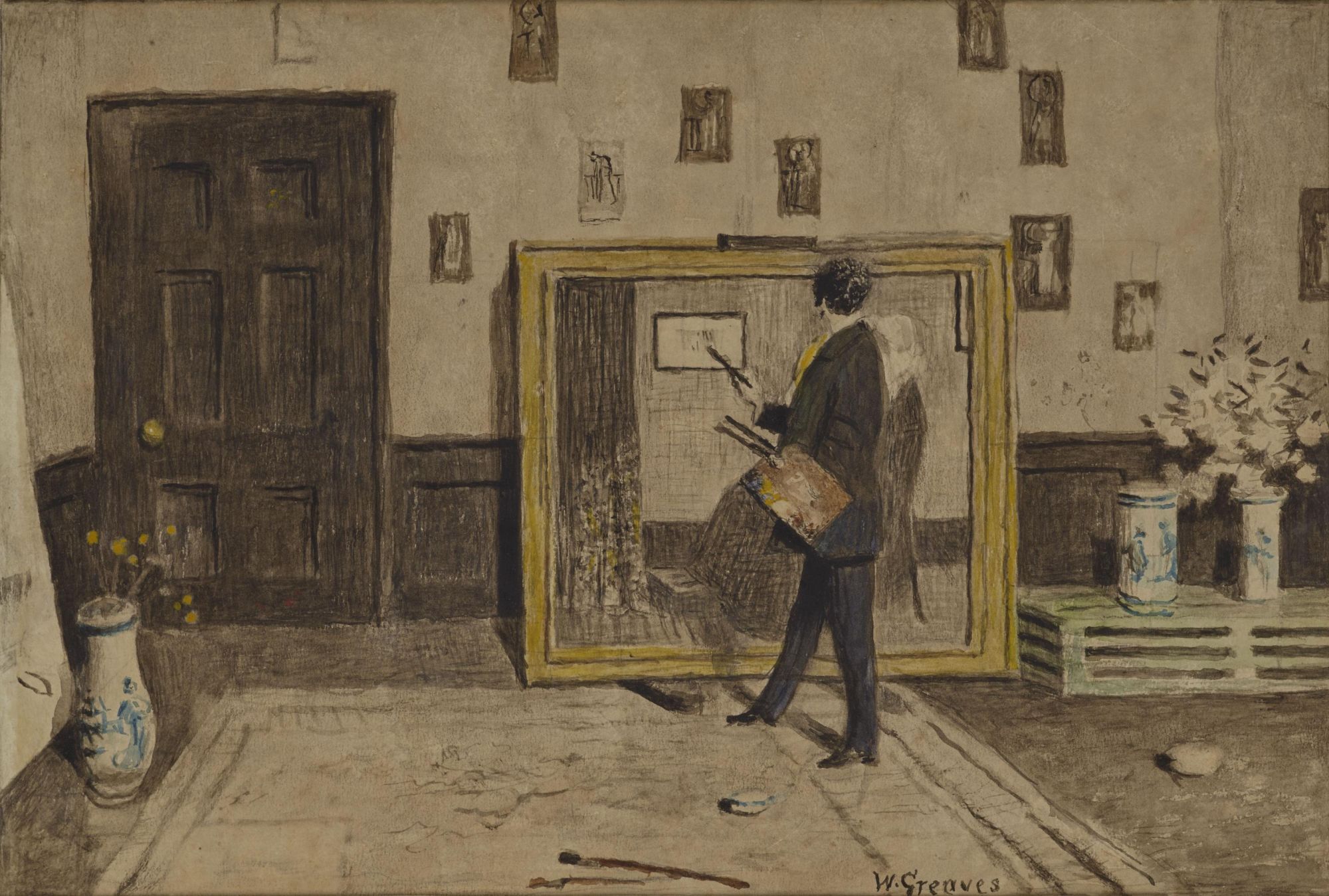
Whistler at his easel, putting the finishing touches to the Portrait of his Mother
Whistler at his easel, putting the finishing touches to the Portrait of his MotherSigned lower right: W. GreavesWatercolour and black chalk with touches of bodycolour22 by 33 cm, 8 ½ by 13 in.Provenance:Private collection, UK until 2025Exhibited:London, Dover St. Arts Club, 1959The present watercolour depicts Whistler putting the finishing touches, to what was to become one of the American artist's most celebrated works, Arrangement in Grey and Black no. 1, or Whistler's Mother, painted in 1871 (now Musée D'Orsay, Paris). Walter Greaves and his brother Harry first met Whistler in 1863, when the latter moved almost next door, to 7 Lindsey Row, Chelsea. The Greaves brothers were boatmen and were employed by Whistler to take him on the Thames and explore the river and its surroundings at different times of the day and night. Their father, also a waterman, had done the same for J.M.W. Turner. Already practicing artists, the Greaves brothers became Whistler's studio assistants, collecting his art supplies and helping to prepare his pigments and his canvases. The two men were hugely influenced by the more successful artist, not only adopting a bolder, looser style in their art, but they even emulated his fashionable way of dressing, wearing similar hats and gloves and even sporting small moustaches. As Whistler became increasingly successful and moved to a more affluent area, he drew back from his friendship with the Greaves brothers and then following his marriage in 1888, he ceased all communication.Whistler was a regular subject for Walter, in pencil, pen or chalk as well as in paintings, captured in all moments, from large full-length portraits, elegantly attired against a backdrop of the Thames, or at work in his studio, as in the present work. Apparently, Whistler's mother, who moved to London in 1863, was popular with Greaves and the opportunity to depict both Whistler and his mother would have appealed to the artist. Greaves continued to paint, following his estrangement from Whistler, however, he struggled to find success and lived in poverty for much of his later life. In 1911, the Goupil Gallery staged an exhibition of Greaves work, which achieved notable critical and commercial success, until Whistler's biographers accused Greaves of plagiarism, destroying Greaves' reputation and forcing him to live as a recluse. However several artists including Sir George Clausen, Augustus John and Walter Sickert, rallied round the artist and Clausen saw to it that the Royal Academy paid Greaves an annual pension of £50. In 1921, William Rothenstein and Augustus John staged another, successful, exhibition of his work which led to Greaves being elected an honorary member of the Chelsea Arts Club.)
Walter Greaves (1846-1930)
Whistler at his easel, putting the finishing touches to the Portrait of his Mother
Signed lower right: W. Greaves
Watercolour and black chalk with touches of bodycolour
22 by 33 cm, 8 ½ by 13 in.
Provenance:
Private collection, UK until 2025
Exhibited:
London, Dover St. Arts Club, 1959
The present watercolour depicts Whistler putting the finishing touches, to what was to become one of the American artist's most celebrated works, Arrangement in Grey and Black no. 1, or Whistler's Mother, painted in 1871 (now Musée D'Orsay, Paris).
Walter Greaves and his brother Harry first met Whistler in 1863, when the latter moved almost next door, to 7 Lindsey Row, Chelsea. The Greaves brothers were boatmen and were employed by Whistler to take him on the Thames and explore the river and its surroundings at different times of the day and night. Their father, also a waterman, had done the same for J.M.W. Turner. Already practicing artists, the Greaves brothers became Whistler's studio assistants, collecting his art supplies and helping to prepare his pigments and his canvases. The two men were hugely influenced by the more successful artist, not only adopting a bolder, looser style in their art, but they even emulated his fashionable way of dressing, wearing similar hats and gloves and even sporting small moustaches. As Whistler became increasingly successful and moved to a more affluent area, he drew back from his friendship with the Greaves brothers and then following his marriage in 1888, he ceased all communication.
Whistler was a regular subject for Walter, in pencil, pen or chalk as well as in paintings, captured in all moments, from large full-length portraits, elegantly attired against a backdrop of the Thames, or at work in his studio, as in the present work. Apparently, Whistler's mother, who moved to London in 1863, was popular with Greaves and the opportunity to depict both Whistler and his mother would have appealed to the artist.
Greaves continued to paint, following his estrangement from Whistler, however, he struggled to find success and lived in poverty for much of his later life. In 1911, the Goupil Gallery staged an exhibition of Greaves work, which achieved notable critical and commercial success, until Whistler's biographers accused Greaves of plagiarism, destroying Greaves' reputation and forcing him to live as a recluse. However several artists including Sir George Clausen, Augustus John and Walter Sickert, rallied round the artist and Clausen saw to it that the Royal Academy paid Greaves an annual pension of £50. In 1921, William Rothenstein and Augustus John staged another, successful, exhibition of his work which led to Greaves being elected an honorary member of the Chelsea Arts Club.