
Study of a Woman smoking
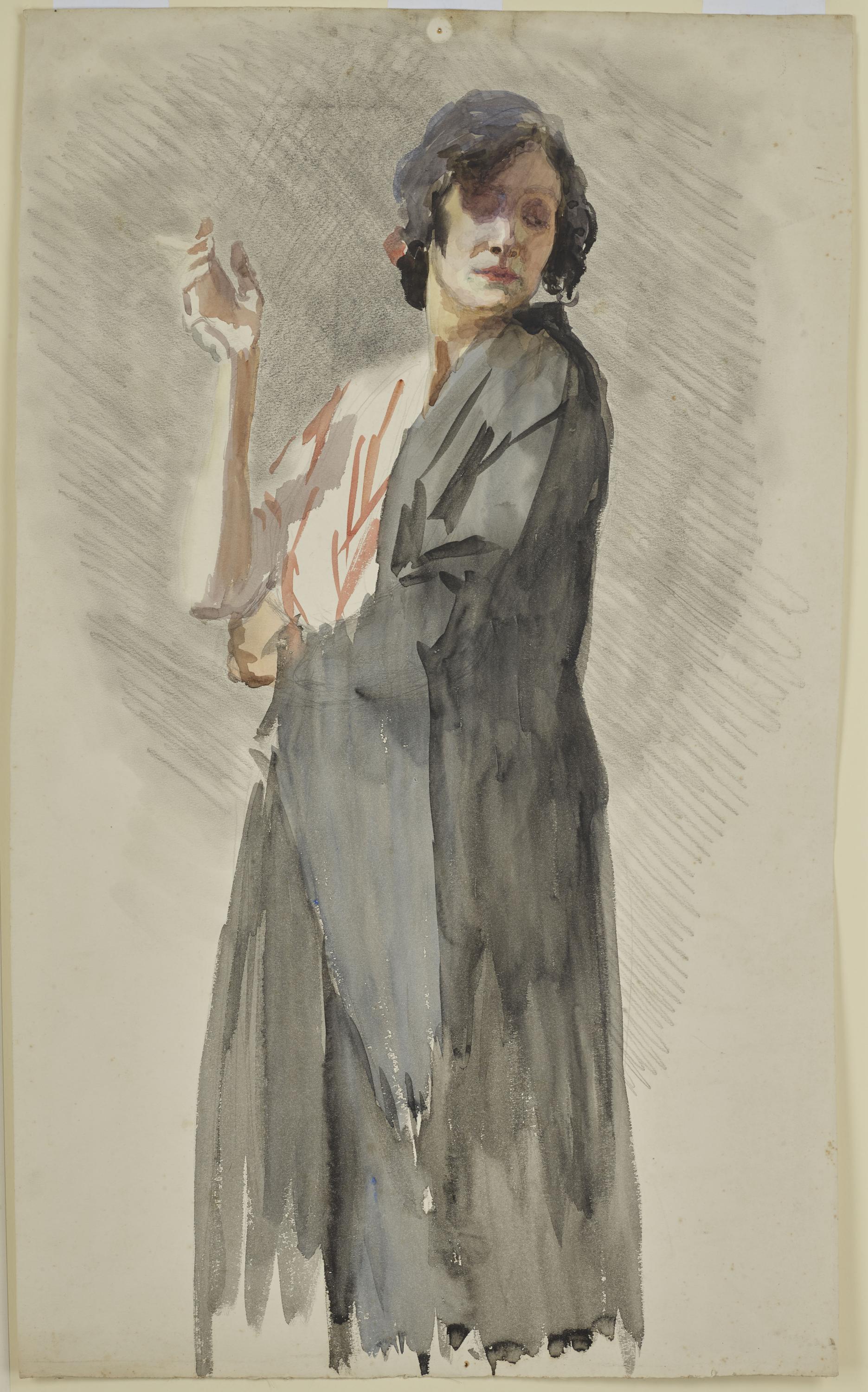
Study of a Woman smoking
3170
Study of a Woman smokingWatercolour over pencil77.7 by 50.3 cm., 30 ½ by 19 ¾ in.Isabel Codrington Pyke-Nott was born near Barnstaple, Devon and enrolled at the Royal Academy School in 1889, at the age of just 15. She first exhibited at the Royal Academy in 1891 and continued to exhibit regularly until about 1912. She used her maiden name following her marriage to her first husband, the journalist and art critic Paul Kondoy (1872-1933) in 1901. They had wide circle of friends including the poet, Ezra Pound, the portrait-painter Philip Alexius de Laszlo and the artist-traveller and former Whistler pupil, Mortimer Menpes. In 1913 Codrington married the art dealer Gustavus 'Dan' Mayer, of P. & D. Colnaghi's in London. Whilst her children were young, she stopped exhibiting for a few years, only beginning again in circa 1918, when she was in her 40s. At this point she dropped the Pyke-Nott from her name. She continued to exhibit regularly, in London including the Royal Academy, as well as in provincial galleries. She also exhibited in Paris throughout the 1920s and 1930s and received an honourable mention in 1923, at the Salon des Artistes Français. Notable solo exhibitions included the Knoedler Galleries in Paris and the Fine Art Society in London in 1926 and 1927. Writing in the Fine Art Society catalogue, Frank Rutter described her work as 'fresh, direct and natural' and 'thrilled by the beauty of colour and texture … she convinces us that … commonplace objects are lovelier than pearls.'She was a highly accomplished artist, who worked in both oil and watercolours producing insightful and sensitively wrought portraits and figure studies, such as the present watercolour, as well as interiors, still-lives and landscapes. She was particularly renowned for her sensitive depictions of rural life and landscape and for her refined draughtsmanship and assured use of colour. An article on her work appeared in The Studio in 1925, where she was described as being 'in the forefront of the movement' to secure recognition for women in the fine arts.)
Isabel Codrington (1874-1943)
Study of a Woman smoking
Watercolour over pencil
77.7 by 50.3 cm., 30 ½ by 19 ¾ in.
Isabel Codrington Pyke-Nott was born near Barnstaple, Devon and enrolled at the Royal Academy School in 1889, at the age of just 15. She first exhibited at the Royal Academy in 1891 and continued to exhibit regularly until about 1912. She used her maiden name following her marriage to her first husband, the journalist and art critic Paul Kondoy (1872-1933) in 1901. They had wide circle of friends including the poet, Ezra Pound, the portrait-painter Philip Alexius de Laszlo and the artist-traveller and former Whistler pupil, Mortimer Menpes.
In 1913 Codrington married the art dealer Gustavus 'Dan' Mayer, of P. & D. Colnaghi's in London. Whilst her children were young, she stopped exhibiting for a few years, only beginning again in circa 1918, when she was in her 40s. At this point she dropped the Pyke-Nott from her name. She continued to exhibit regularly, in London including the Royal Academy, as well as in provincial galleries. She also exhibited in Paris throughout the 1920s and 1930s and received an honourable mention in 1923, at the Salon des Artistes Français. Notable solo exhibitions included the Knoedler Galleries in Paris and the Fine Art Society in London in 1926 and 1927. Writing in the Fine Art Society catalogue, Frank Rutter described her work as 'fresh, direct and natural' and 'thrilled by the beauty of colour and texture … she convinces us that … commonplace objects are lovelier than pearls.'
She was a highly accomplished artist, who worked in both oil and watercolours producing insightful and sensitively wrought portraits and figure studies, such as the present watercolour, as well as interiors, still-lives and landscapes. She was particularly renowned for her sensitive depictions of rural life and landscape and for her refined draughtsmanship and assured use of colour. An article on her work appeared in The Studio in 1925, where she was described as being 'in the forefront of the movement' to secure recognition for women in the fine arts.