
The Married Man or The Happy Family
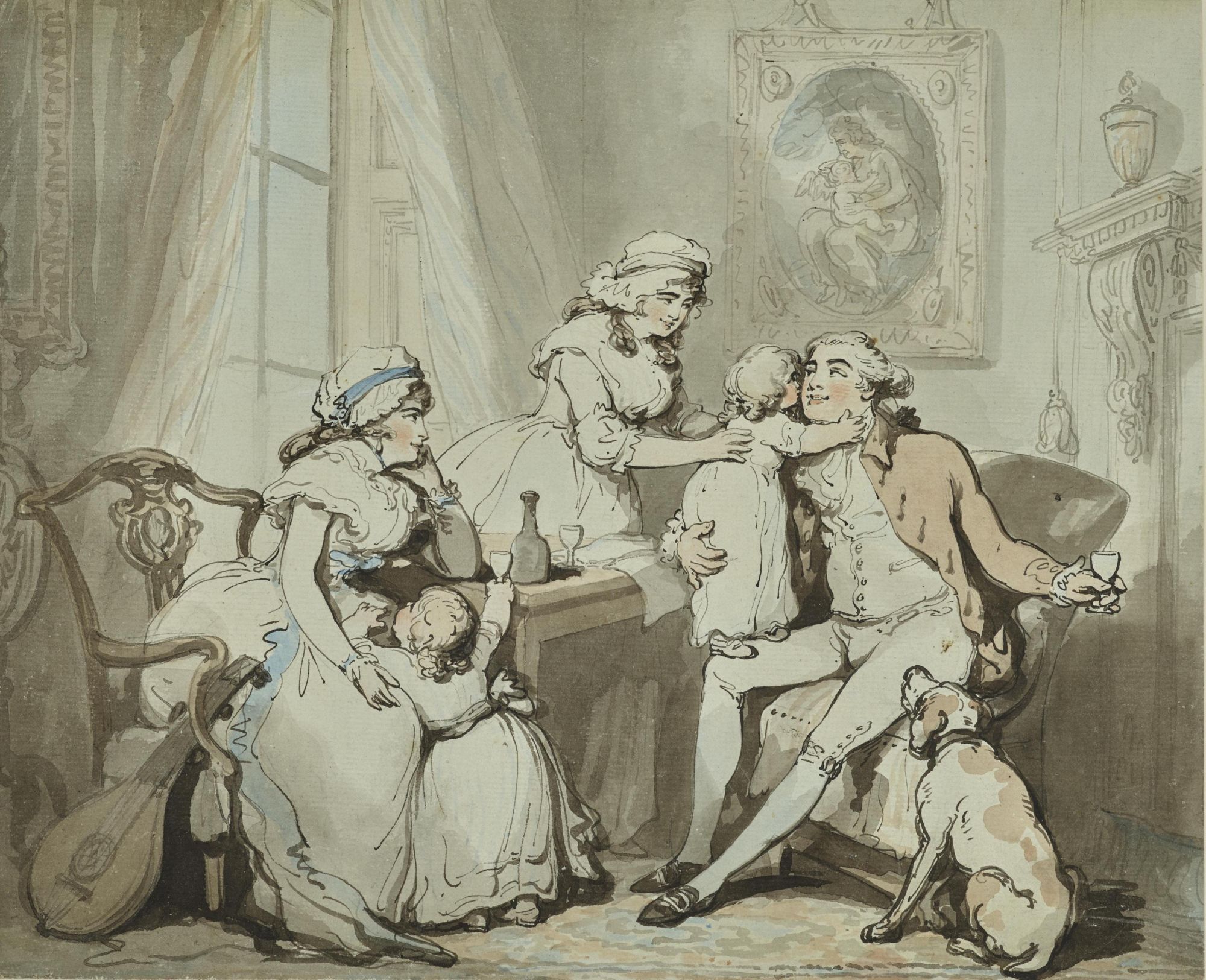
The Married Man or The Happy Family
The Married Man or The Happy FamilyPen and grey ink and watercolour over pencil25 by 30.5 cm., 9 ¾ by 12 in.Provenance:The Wauchope Family;Sir David Ross, K.B.E.(1877-1971);With Leger Galleries, London, 1975;Mary Burkhart, USA, 1999;Anonymous sale, Christie's, 21st November 2002, lot 16;With Lowell Libson, London, where acquired by Irene Roosevelt Aitken, 2008;By descent until 2026Literature:Joseph Grego, Rowlandson the Caricaturist, 1880, vol. II, p.391;John Hayes, Rowlandson, Watercolours and Drawings, 1972, p. 120, no.56, ill.;J. Steel (ed.), Mr Rowlandson's England, London, 1985, p. 33, ill.;Desmond Shawe Taylor, The Georgians: Eighteenth Century Portraiture and Society, London, 1990, p.184, ill. fig.123;Lowell Libson, Beauty and the Beast: A loan Exhibition of Rowlandson's Works from British private Collections, 2007, no.1Exhibited:London, Leger Galleries, 8 December 1975-16 January 1976, no. 1.London, Lowell Libson, Beauty and the Beast: A loan Exhibition of Rowlandson's Works from British private Collections, 2007, no.1Engraved:By Samuel Alken and published by S.W. Fores, 28th December 1786 (and reissued 18th March 1790)Described by John Hayes as 'an essay in the manner of Wheatley demonstrating the contentments of domestic life' (op. cit, p. 120), the present watercolour is relatively unusual for the artist, in being a straightforward, serene depiction of domestic harmony and completely without any of the more typical elements of caricature. The overall feeling of harmony is emphasized by elements such as the lute resting by the mother's chair, a traditional symbol of harmony, the dog sitting looking up at his master, which represents faithfulness. The painting on the wall behind the family group of Cupid and Venus is symbolic of love and their pose is reflected in the embrace between father and child. The influence of Thomas Gainsborough, whose work Rowlandson much admired is evident in the rapidly handled, sophisticated rococo line that the artist has employed in the present watercolour, combined with the gentle palette, 'pale but sympathetic to the mood of the subject-matter, to sing out in broad, clean washes' (Hayes, op. cit., p.120) all emphasize the gentle and harmonious nature of the workThis watercolour is a rare example of the artist looking at and interpreting more conventional types of art. In composition, it echoes the conversation pieces that had become increasingly popular during the period. From the mid 1720s there began a move away from formal portraits towards more relaxed depictions, with the sitters engaged in activities, or grouped together informally in domestic or garden settings. Artists such as Philip Mercier, William Hogarth, Arthur Devis and later Thomas Gainsborough and Johann Zoffany were instrumental in popularizing this more informal form of portraiture. In 1786 the work was engraved and was accompanied by the following pair of couplets:'When Hymen joins the Lover and the FairLove spreads his guardian pinions o'er the pair;The smiles of Sweet Contentment cheer his dome,And all the pleasures make his house their Home.'This work is variously called, The Happy Family, The Married Man and The Birthday Party. It is interesting to note the similarity between the features of the father and those of the artist, which has led to the suggestion that Rowlandson is conveying some of his own desires for domestic harmony and a family, in the present work.)
Thomas Rowlandson (1756-1827)
The Married Man or The Happy Family
Pen and grey ink and watercolour over pencil
25 by 30.5 cm., 9 ¾ by 12 in.
Provenance:
The Wauchope Family;
Sir David Ross, K.B.E.(1877-1971);
With Leger Galleries, London, 1975;
Mary Burkhart, USA, 1999;
Anonymous sale, Christie's, 21st November 2002, lot 16;
With Lowell Libson, London, where acquired by Irene Roosevelt Aitken, 2008;
By descent until 2026
Literature:
Joseph Grego, Rowlandson the Caricaturist, 1880, vol. II, p.391;
John Hayes, Rowlandson, Watercolours and Drawings, 1972, p. 120, no.56, ill.;
J. Steel (ed.), Mr Rowlandson's England, London, 1985, p. 33, ill.;
Desmond Shawe Taylor, The Georgians: Eighteenth Century Portraiture and Society, London, 1990, p.184, ill. fig.123;
Lowell Libson, Beauty and the Beast: A loan Exhibition of Rowlandson's Works from British private Collections, 2007, no.1
Exhibited:
London, Leger Galleries, 8 December 1975-16 January 1976, no. 1.
London, Lowell Libson, Beauty and the Beast: A loan Exhibition of Rowlandson's Works from British private Collections, 2007, no.1
Engraved:
By Samuel Alken and published by S.W. Fores, 28th December 1786 (and reissued 18th March 1790)
Described by John Hayes as 'an essay in the manner of Wheatley demonstrating the contentments of domestic life' (op. cit, p. 120), the present watercolour is relatively unusual for the artist, in being a straightforward, serene depiction of domestic harmony and completely without any of the more typical elements of caricature. The overall feeling of harmony is emphasized by elements such as the lute resting by the mother's chair, a traditional symbol of harmony, the dog sitting looking up at his master, which represents faithfulness. The painting on the wall behind the family group of Cupid and Venus is symbolic of love and their pose is reflected in the embrace between father and child.
The influence of Thomas Gainsborough, whose work Rowlandson much admired is evident in the rapidly handled, sophisticated rococo line that the artist has employed in the present watercolour, combined with the gentle palette, 'pale but sympathetic to the mood of the subject-matter, to sing out in broad, clean washes' (Hayes, op. cit., p.120) all emphasize the gentle and harmonious nature of the work
This watercolour is a rare example of the artist looking at and interpreting more conventional types of art. In composition, it echoes the conversation pieces that had become increasingly popular during the period. From the mid 1720s there began a move away from formal portraits towards more relaxed depictions, with the sitters engaged in activities, or grouped together informally in domestic or garden settings. Artists such as Philip Mercier, William Hogarth, Arthur Devis and later Thomas Gainsborough and Johann Zoffany were instrumental in popularizing this more informal form of portraiture.
In 1786 the work was engraved and was accompanied by the following pair of couplets:
'When Hymen joins the Lover and the Fair
Love spreads his guardian pinions o'er the pair;
The smiles of Sweet Contentment cheer his dome,
And all the pleasures make his house their Home.'
This work is variously called, The Happy Family, The Married Man and The Birthday Party. It is interesting to note the similarity between the features of the father and those of the artist, which has led to the suggestion that Rowlandson is conveying some of his own desires for domestic harmony and a family, in the present work.